For many small manufacturing businesses, welding is an essential production process but also one of the most labor-intensive operations. Rising labor costs, difficulty finding skilled welders, and increasing customer expectations for consistent quality are encouraging more small manufacturers to consider robotic welding.
However, choosing the right automation system can be challenging.
A small factory does not necessarily need the largest or most advanced robotic welding line. The best welding robot for a small manufacturing business is the one that matches the company's actual production volume, workpiece requirements, available factory space, welding process, and future automation plans.
LIGENT Robot provides industrial welding robots and supporting automation equipment designed for different manufacturing applications, allowing small and medium-sized manufacturers to select a solution according to their specific production requirements.
Small manufacturers often face the same production challenges as larger factories, but with fewer resources.
Common challenges include:
Difficulty recruiting experienced welders
Increasing labor costs
Inconsistent welding quality
Repetitive manual welding operations
Limited production capacity
Pressure to deliver orders faster
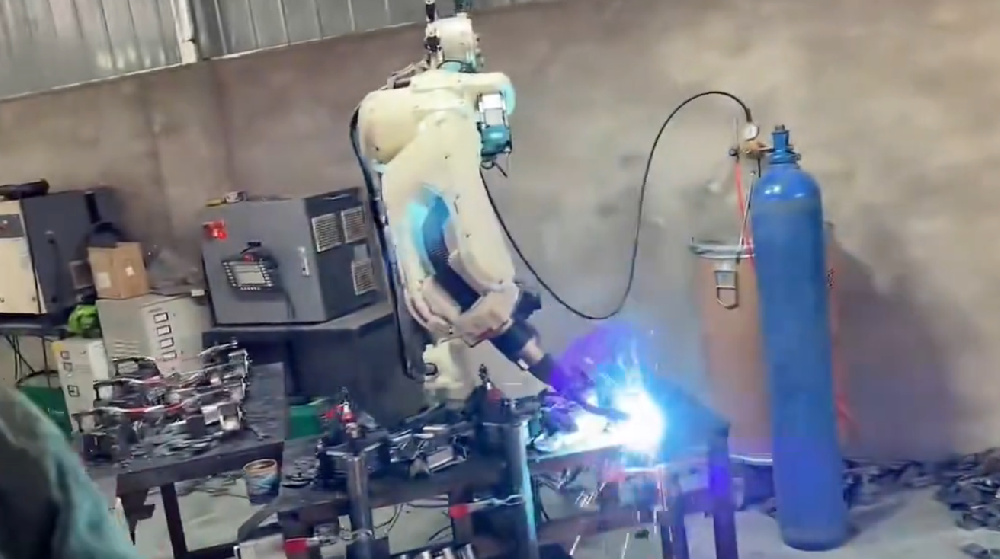
For companies producing metal components, machinery parts, automotive components, frames, and other welded products, robotic welding can automate repetitive operations while allowing employees to focus on higher-value production tasks.
LIGENT has specifically highlighted labor shortages, high labor costs, and welding quality as key challenges for small and medium-sized manufacturing enterprises.
There is no single welding robot that is best for every small manufacturer.
The right choice depends on several important factors.
Production volume should be one of the first considerations.
A company producing the same component repeatedly may benefit from a dedicated robotic welding workstation.
A manufacturer producing customized products or small batches may need a more flexible robot that can be programmed for multiple welding applications.
The objective is to choose a robot that can provide a reasonable return on investment based on actual production requirements.
The dimensions and weight of the workpiece directly affect robot selection.
Manufacturers should evaluate:
Workpiece dimensions
Workpiece weight
Welding position
Required robot reach
Required payload
A robot with excessive capacity may increase unnecessary investment, while a robot that is too small may not be able to complete the application effectively.
For this reason, the best welding robot for small manufacturing business should be selected according to the actual workpiece rather than simply choosing the smallest available model.
Different manufacturing applications require different welding technologies.
Common processes include:
MIG welding
MAG welding
TIG welding
ARC welding
Laser welding
LIGENT's welding robot portfolio supports TIG, MIG/MAG, and laser welding applications, while its industrial robot solutions also cover ARC welding applications.
Manufacturers should determine the required welding process before selecting the robot and welding equipment.
Factory space can be a major consideration for small businesses.
A large automated production line may require significant floor space for the robot, positioner, safety equipment, material handling, and operator access.
For factories with limited space, a compact robotic welding workstation may be more practical.
LIGENT offers small six-axis robots as well as welding robots and supporting equipment, allowing different system configurations to be considered according to the available workspace.
A small business may grow significantly over time.
When selecting a welding robot, manufacturers should consider not only today's production requirements but also possible future applications.
A flexible robotic system can potentially be expanded with:
Positioners
Linear rails
Additional welding equipment
Different robot programs
Additional automation stations
LIGENT provides positioners and linear rails alongside its industrial robots, making it possible to configure robotic welding systems around different production requirements.
A robot can repeatedly follow programmed welding paths, helping manufacturers achieve more consistent welding performance.
This can reduce variations caused by differences in operator technique, fatigue, or working conditions.
Consistent welding can be particularly important for small manufacturers because rework and defective products can have a significant impact on production costs.
Welding robots can take over repetitive welding operations while operators focus on:
Loading and unloading
Quality inspection
Production monitoring
Robot programming
Material preparation
This can help small manufacturers make better use of skilled employees.
Robotic welding can maintain a stable production cycle for suitable repetitive applications.
Instead of depending entirely on manual welding speed, manufacturers can use programmed robot movements and welding parameters to achieve more consistent production performance.
Automation can help manufacturers increase production capacity without relying solely on increasing the number of manual welding workers.
For a growing small business, this can make robotic welding an important part of a longer-term manufacturing strategy.
Small businesses should not assume that a larger robot automatically provides a better solution.
A smaller or more compact system may be more appropriate when the manufacturer has:
Low or medium production volume
Multiple product models
Limited factory space
Smaller workpieces
Frequent product changes
A larger system may be more appropriate for:
High-volume production
Large workpieces
Heavy components
Long continuous welding operations
Dedicated production lines
The best solution is therefore the one that matches the manufacturing process.
Before purchasing a robotic welding system, small manufacturers should consider more than the initial equipment price.
A basic evaluation can include:
Estimate the annual cost of the welding labor currently required for the application.
Calculate how many products can be produced manually compared with the expected robotic production cycle.
Consider the potential cost of inconsistent welding quality and repeated production.
A robot that is only used occasionally may provide a slower return on investment than one operating regularly.
Consider whether the robot can be used for additional products or welding tasks as the business grows.
This approach allows manufacturers to evaluate automation based on total production value rather than equipment price alone.
LIGENT Robot provides industrial robotic solutions covering welding, handling, small six-axis robots, collaborative robots, positioners, and linear rails.
Its welding robot portfolio includes models such as the ST10-2050K, ST15-1550K, ST10-1500K, SK12-2010, ST10-2010K, and SK10-1440, providing different payload and working-range configurations for different applications.
LIGENT also provides compact six-axis robot models and collaborative robots, giving manufacturers additional options when production requirements, workspace, or application flexibility differ.
For small manufacturing businesses, the right solution can be selected according to:
Product type
Workpiece size
Production volume
Welding process
Factory space
Required automation level
Future production plans
Before choosing a welding robot, manufacturers should prepare answers to several basic questions:
What products need to be welded?
Understanding the workpiece is the first step toward selecting the right robot.
How many products are produced per day or month?
Production volume helps determine whether a robotic workstation can provide a reasonable return on investment.
Which welding process is required?
MIG/MAG, TIG, ARC, and laser welding may require different equipment configurations.
How much factory space is available?
The available space affects robot selection and workstation design.
Will the robot need to handle multiple products?
If production changes frequently, flexibility should be prioritized.
For a small manufacturing business, investing in a welding robot is not simply about purchasing an industrial machine. It is about finding the right balance between production requirements, automation capabilities, investment, and future growth.
The best welding robot for small manufacturing business is one that can solve a real production problem while providing enough flexibility to support future needs.
With the right robotic welding solution, small manufacturers can improve welding consistency, reduce repetitive labor, increase production efficiency, and build a more competitive manufacturing process.
LIGENT Robot provides flexible welding robot and automation solutions for manufacturers looking to take the next step toward robotic production.
Contact LIGENT Robot to discuss your products, welding process, production volume, and factory conditions, and find a suitable welding automation solution for your business.