Steel parts manufacturing involves a wide variety of components, from brackets and frames to machinery components, automotive parts, supports, and fabricated assemblies. Many of these products contain repetitive welding joints that require consistent positioning, welding speed, and torch movement.
For manufacturers producing steel components on a regular basis, robotic welding can provide a more repeatable approach to production.
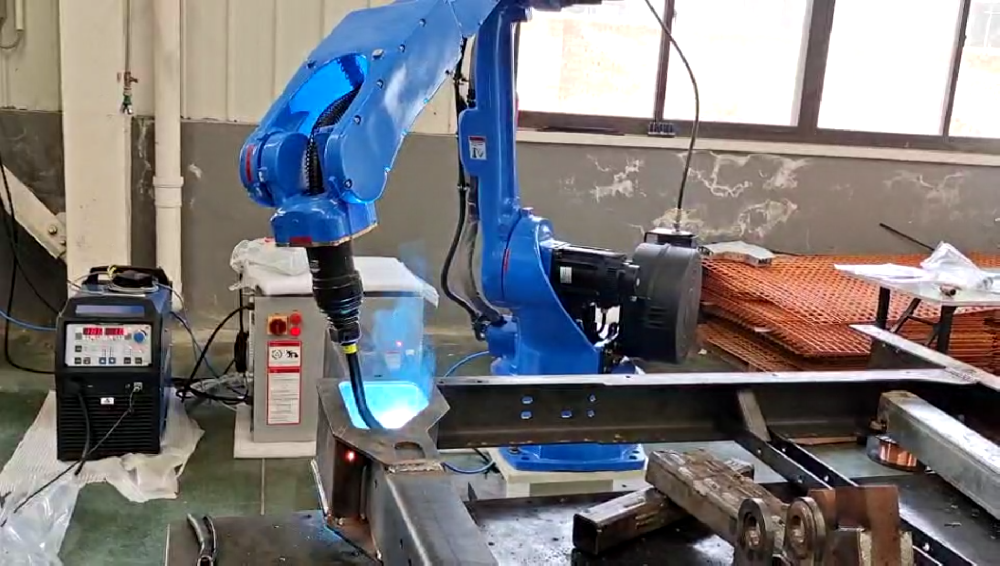
A robot welder for steel parts can automate repetitive welding operations while allowing manufacturers to build a more standardized production process. For companies looking to improve their welding operations, a robot welder for steel parts manufacturing can be integrated with fixtures, positioners, welding equipment, and other automation components according to the application.
LIGENT Robot provides industrial welding robots and supporting automation equipment for different manufacturing applications.
Many steel components share a common characteristic: their welding operations are repetitive.
A manufacturer may produce hundreds or thousands of similar parts, with each part requiring the same or similar welding joints.
Typical examples include:
Steel brackets
Metal frames
Machinery components
Automotive parts
Equipment supports
Metal bases
Steel housings
Structural components
Fabricated steel assemblies
When the workpiece design and welding process are sufficiently consistent, a robot can repeatedly follow a programmed welding path.
This makes robotic welding particularly useful for manufacturers that want to reduce variations between production cycles.
For steel component manufacturers, production consistency is often as important as production speed.
Manual welding can introduce variations in torch movement, travel speed, welding angle, and positioning. These differences may become more noticeable when a manufacturer produces a large number of similar components.
A robotic welding system can execute programmed movements repeatedly under controlled production conditions.
The robot can maintain a defined welding path while the fixture keeps the workpiece in a predetermined position.
This combination can help manufacturers establish a more repeatable welding process.
A complete robotic welding solution normally consists of several components working together.
A typical system may include:
Industrial robot + welding power source + welding torch + fixture + positioner + safety system
Depending on the application, additional equipment may also be required.
LIGENT provides welding robots together with supporting equipment such as welding workbenches, positioners, linear rails, and gun cleaning stations. These components can be configured according to different production requirements.
This approach allows manufacturers to develop a complete welding cell instead of treating the robot as an independent machine.
Steel components are often welded on multiple sides or contain joints located at different angles.
Manually repositioning every component can add unnecessary handling time and make the welding process less consistent.
A positioner can rotate or reposition the workpiece so that the robot can access different welding areas more efficiently.
For example, LIGENT offers several positioner configurations with different load capacities and dimensions, as well as light and heavy linear rails for applications requiring additional robot movement.
The appropriate configuration depends on the component geometry, weight, welding joints, and required production cycle.
Steel parts can require different welding processes depending on material, thickness, joint design, production requirements, and desired weld characteristics.
Robotic welding can be used with common industrial processes such as:
MIG welding
MAG welding
TIG welding
ARC welding
Laser welding
LIGENT's welding robot platform supports TIG, MIG/MAG, laser, and other welding applications listed on its website.
This allows manufacturers to develop robotic welding solutions around their existing production process rather than using the same welding method for every steel component.
One of the strongest applications for a robot welder for steel parts manufacturing is repeated component production.
Consider a manufacturer producing a steel bracket with six identical welding joints.
A manual process requires the operator to position the component, perform the welds, inspect the part, and repeat the operation.
With a properly designed robotic welding cell, the operator can load the prepared component into the fixture while the robot performs the programmed welding sequence.
The basic production cycle can become:
Load → Position → Weld → Inspect → Unload
The exact process depends on the product and system configuration, but the principle remains the same: repetitive welding movements are transferred from manual operation to a programmable machine.
Steel components vary significantly in size and geometry.
A small bracket may require a compact robot, while larger fabricated components may require a robot with greater reach or additional movement through a linear rail.
LIGENT's current welding robot range includes different six-axis models, including:
SK12-2010
ST15-1550K
ST10-2050K
SK10-1440
The listed models provide different payload and working-range configurations, allowing a robotic welding system to be developed around the application requirements.
For larger or more complex applications, additional positioning or linear movement can also be considered.
Steel parts manufacturers do not always produce only one product.
Job shops and component suppliers may manufacture different parts for multiple customers. In these situations, programming flexibility becomes important.
A six-axis welding robot can be programmed for different welding paths and production routines.
With suitable fixtures and production procedures, the same robotic welding platform may be used for multiple related components.
This can make robotic welding useful for manufacturers with several product families rather than only highly specialized mass-production lines.
For steel parts suppliers, consistent production can influence both internal manufacturing efficiency and downstream assembly.
A welding variation may affect:
Part dimensions
Joint appearance
Assembly accuracy
Rework requirements
Inspection results
Production consistency
By standardizing robot movement, fixture positioning, and welding parameters, manufacturers can create a more controlled welding process.
Robotic welding does not eliminate the need for process engineering or inspection, but it can provide a repeatable platform for production.
LIGENT Robot is an industrial robot and automation provider offering welding robots and related automation equipment.
Its product portfolio includes welding robots, handling robots, small six-axis robots, collaborative robots, positioners, linear rails, welding workbenches, and gun cleaning stations.
LIGENT's welding robots are designed for industrial welding applications and support processes including MIG/MAG, TIG, laser, and ARC welding. The company also lists automotive parts and construction machinery among its industrial application areas.
For steel parts manufacturers, this allows robotic welding equipment to be configured around the actual component, welding process, and production workflow.
There is no single robotic welding configuration suitable for every steel component.
A practical system may require different combinations of:
Six-axis welding robot
Welding power source
Custom fixture
Positioner
Linear rail
Safety equipment
Gun cleaning station
Welding workbench
The correct combination depends on the steel part, joint configuration, production volume, and required automation level.
Instead of simply purchasing a robot, manufacturers can work with an automation supplier to develop a welding cell around the actual production process.
For manufacturers producing repetitive steel components, robotic welding can provide a path toward more standardized production.
The objective is not simply to make the robot weld faster. A well-designed system should combine robot movement, workpiece positioning, welding equipment, fixtures, and operator workflow into one coordinated process.
With the right application, a robot welder for steel parts can help manufacturers improve repeatability and establish a more stable production method.
For companies searching for a robot welder for steel parts manufacturing, LIGENT Robot provides industrial welding robots and supporting automation equipment for different steel component applications.
Contact LIGENT Robot to discuss your steel parts welding application and develop a robotic welding solution for your production process.